
Last verified: April 2026
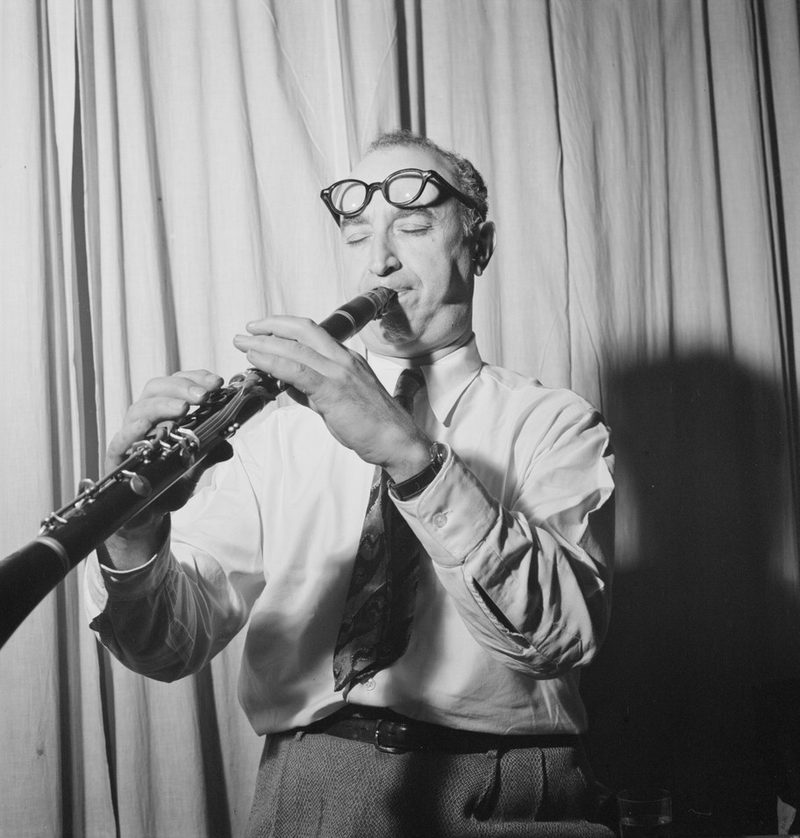
Mezzrow
Milton "Mezz" Mezzrow was born on November 9, 1899, in Chicago, to a Russian-Jewish immigrant family. He learned clarinet and saxophone in his teens and began performing professionally in the early 1920s. His musical aspiration was unusual: he wanted to play in the Black New Orleans–Chicago jazz tradition rather than in the contemporary white-dominated commercial music of the era.
By the late 1920s, Mezzrow had moved into the Black jazz milieu in Chicago, performing alongside or in proximity to musicians like Louis Armstrong, King Oliver, Earl Hines, and others associated with the post-Storyville Chicago scene. He continued in this milieu through the 1930s, moving to New York and the Harlem scene where he attached himself to the working-musician community around the Cotton Club, the Savoy Ballroom, and the various "tea pads" that operated in the era.
Mezzrow self-identified as Black culturally and racially in ways that complicated his life and biography. In his autobiography Really the Blues (1946, co-written with Bernard Wolfe), he describes a process of "voluntary Negroness" that he saw as authentic identification with the Black jazz culture he loved. Modern critics have read this complicated identification with varying assessments — sympathetically as deep cross-racial solidarity, more critically as cultural appropriation. The complexity is part of why Mezzrow remains a contested figure in jazz historiography.
The Cannabis Operation
By his own admission in Really the Blues, Mezzrow was a major cannabis retailer in 1930s Harlem. He describes the operation in extensive detail:
- Source. He sourced cannabis from Mexican and Caribbean importers, with some wholesale supplied through New York port-trade channels
- Quality. He emphasized high-quality product, professionally rolled cannabis cigarettes that became known as "Mezz" or "Mezzroles"
- Customer base. Working musicians — Louis Armstrong, Duke Ellington, Cab Calloway, Fats Waller, Sidney Bechet, Billie Holiday, and many more — were among his customers
- Price. The premium was justified by reliability and quality at a moment when much cannabis available was poor or adulterated
- Operation. He sold from various Harlem locations, with the Savoy Ballroom area and corners around 131st and Lenox figuring prominently in his account
Mezzrow's cannabis operation operated in a legal-and-cultural gray zone. He was not arrested for cannabis specifically in the 1930s. His 1940 arrest came at a moment of intensified federal-cannabis enforcement under Anslinger's framework: he was arrested at the Pennsylvania Hotel in New York for cannabis possession, served jail time, and continued in the music scene afterwards.
The Word "Mezz"
Mezzrow's cannabis became so identified with high-quality product that "a mezz" (or "a Mezzrole") came to mean a cannabis cigarette of premium quality. The slang entered jazz vocabulary in the 1930s and survives in jazz scholarship and historiography. Louis Armstrong's correspondence makes explicit reference to Mezzrow's product; other musicians' diaries and interviews reference "Mezzrow's" or "the Mezz."
"Sendin' the Vipers" — Mezzrow's 1934 recording — is a primary musical document of the 1930s viper culture, with Mezzrow himself on clarinet leading a small group through what was understood at the time as a cannabis-themed performance.
Really the Blues (1946)
Mezzrow's autobiography Really the Blues, co-written with Bernard Wolfe, was published in 1946. It is one of the most important primary documents of mid-century cannabis-cultural history. The book covers:
- Mezzrow's musical formation in 1920s Chicago
- His relationships with Louis Armstrong and other Black New Orleans–Chicago musicians
- The cannabis operation in 1930s Harlem in extensive detail
- The viper culture, the tea pads, the songs, the linguistic vocabulary
- The Anslinger-era enforcement and its impact on Mezzrow and his musician customers
- His 1940 arrest and incarceration
- His postwar musical work and continued involvement in the jazz scene
The book has been continuously in print since 1946 and is widely regarded as essential reading for cannabis-cultural history, jazz history, and 20th-century race-and-cultural-history. Its credibility on factual details has been generally upheld by subsequent scholarship, though Mezzrow's self-presentation and cross-racial identification claims have been increasingly debated.
The Vipers as a Cultural Movement
The 1930s viper culture — of which Mezzrow was a central retail figure — constituted something more than a drug-using community. The vipers were:
- A musical subculture — overlapping substantially with the working-jazz-musician community in Harlem and Chicago
- A linguistic community — sharing the vocabulary documented on the Jazz Cannabis Vocabulary page
- A self-identifying group — distinct from drinkers, distinct from harder-drug users, distinct from straight ("square") society
- A defensive community — increasingly aware, through the early 1930s, of the federal-prohibition framework being built against them
- A racially mixed community — predominantly Black but with a meaningful white-musician participation, of which Mezzrow himself was the most visible figure
The viper community produced its own ethics, its own songs, its own slang, its own preferred performance contexts. "If You're a Viper" (Stuff Smith, 1936) is the genre-defining anthem; multiple subsequent recordings (Fats Waller, Sidney Bechet, Mezzrow himself) consolidated the song's cultural status.
The Suppression
The federal-prohibition apparatus built under Anslinger (see Anslinger & Louisiana) targeted the viper community directly. Anslinger's lists of musicians for surveillance, his press campaigns framing cannabis use as Black-musician-driven contagion, his bureau's sustained harassment of working musicians — all this had the effect of dismantling the viper community as a cultural-public force by the late 1940s.
The community survived into the 1950s in modified form: more underground, more cautious, more concerned with avoiding federal attention. By the 1960s counterculture era, when cannabis use exploded into white middle-class American culture, the original Black-musician viper community had become a historical reference point rather than a living cultural movement. The new cannabis users brought their own vocabulary ("grass," "pot," "weed") and their own cultural framing.
Mezzrow's Later Life
Mezzrow continued performing through the 1950s and 1960s, eventually relocating to Paris in the 1950s where he played in a more sympathetic European jazz environment. He died in Paris on August 5, 1972. His later recordings and the various interviews and writings he produced through the 1950s and 1960s are part of the broader documentary record of mid-century cannabis-cultural history.
The Modern Reading
Mezzrow remains a contested figure in modern cannabis-cultural and jazz historiography. Sympathetic readings emphasize his deep musical commitment, his cross-racial solidarity, his preservation through Really the Blues of essential documentation that would otherwise have been lost. Critical readings emphasize his complicated self-positioning, the cultural-appropriation dimensions of his "voluntary Negroness," and the imbalance of power between a white retailer and his Black musician customers in a federally prohibited drug market.
Both readings acknowledge Mezzrow's centrality to the historical record. Really the Blues remains essential reading; Mezzrow's musical recordings remain part of the standard early-jazz canon; "Mezz" as a slang term and cultural marker remains part of the cannabis-cultural vocabulary. New Orleans's contribution to this lineage — through the Storyville-era musicians who later worked alongside Mezzrow, through Louis Armstrong's lifelong friendship and creative partnership with him, through the broader cultural migration that brought New Orleans cannabis culture north — is part of what gives the Mezzrow story its larger significance.
For in-depth cannabis education, dosing guides, safety information, and research summaries, visit our partner site TryCannabis.org
Related on this site: Louis Armstrong & "Muggles", Storyville (1897–1917), Send a Message.