Last verified: April 2026
What Mardi Gras Actually Is
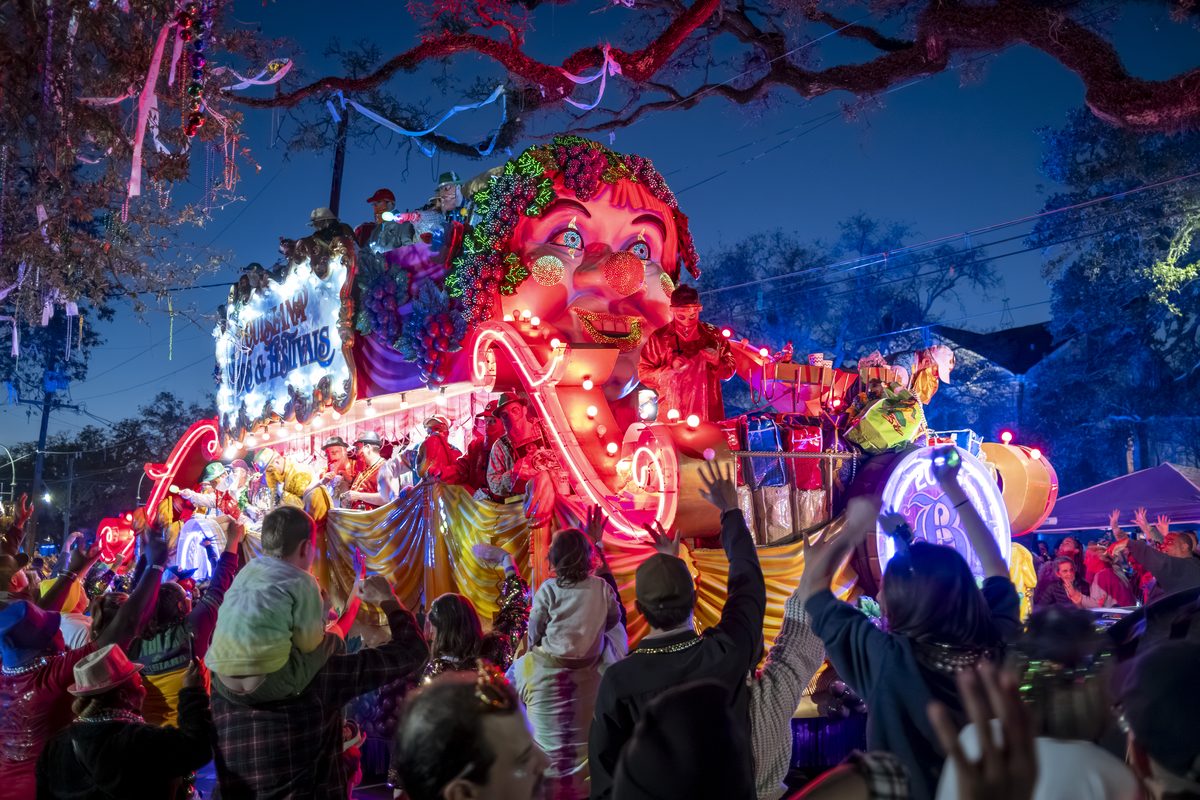
Mardi Gras — French for "Fat Tuesday" — is the day immediately before Ash Wednesday, the start of the Catholic Lenten fasting period. In New Orleans, "Mardi Gras" colloquially refers to the entire Carnival season from Twelfth Night (January 6) through Fat Tuesday itself, but the tourist-defining run is the final two weeks: parades begin in earnest the second weekend before Fat Tuesday and culminate with the Rex and Zulu day-parades on Fat Tuesday morning.
Krewes — the social organizations that throw the parades — date back to the mid-19th century. The biggest "super krewes" (Endymion, Bacchus, Orpheus) draw stadium-scale crowds; older traditional krewes (Comus, Momus, Proteus, Rex) have smaller, often invitation-only routes. Mardi Gras Indians — Black masking traditions tied to neighborhood culture and 19th-century Native American protection of escaped enslaved people — operate parallel to krewe parades.
The Three Tiers of Mardi Gras Cannabis Posture
Tier 1: Inside private homes, balconies, courtyard parties, hotel rooms
The legal posture for personal-use possession or consumption inside private space during Mardi Gras is identical to the rest of the year: NOPD does not enter to investigate odor alone; the DA does not prosecute simple possession. Private parties at homes throughout the Quarter, Marigny, Garden District, and Uptown are largely unaffected by the increased police presence outside.
Tier 2: On the parade route, on Bourbon Street, on the street generally
This is where the posture tightens. NOPD officer density during the final weekend before Fat Tuesday is multiples of normal — supplemented by Louisiana State Police (with state-law authority on the streets, not just interstates), Jefferson Parish deputies on lower St. Charles, and federal agents at certain checkpoints. Custodial arrest for simple possession is still rare — the §54-507 cite-and-release ordinance applies — but the probability of being seen, stopped, or smelled rises dramatically. Open consumption on Bourbon Street will draw an officer's attention; the officer will likely write the summons rather than book.
Tier 3: On parade floats, in marching bands, in official capacity
Krewes and parade organizations have their own rules. Riders on floats are licensed and bonded; cannabis use is a krewe-internal violation that can result in losing your spot. Marching bands, particularly high-school and college bands brought in for the parades, are subject to school disciplinary policy. Cannabis is not a Mardi Gras-route privilege.
The Bourbon Street Open-Container Paradox
New Orleans permits open-container alcohol in unopened or disposable plastic cups on most public streets. This is a long-standing local exception that survives modern open-container reform elsewhere. The rule is enshrined in the City Code and is not specific to Mardi Gras — it applies year-round.
This rule does not extend to cannabis. No Louisiana statute or New Orleans ordinance authorizes open-container cannabis. The decriminalization under §54-507 reduces the penalty for possession to a $40–$100 municipal summons; it does not authorize public consumption. Smoking a joint while walking down Bourbon Street with a daiquiri in your other hand is still subject to the §54-507 summons, plus any additional consumption-related municipal nuisance ordinances.
For the full breakdown, see Bourbon Street: Open-Container Alcohol Yes, Cannabis No.
Vapes, Edibles, Hidden Forms
Discreet forms — vape pens, edibles, sealed gummies — are functionally undetectable on a parade route in dense crowd conditions. NOPD does not search for vape pens at Mardi Gras. The legal status of consumption is unchanged (still a §54-507 violation if observed), but the practical detection rate is near zero. Most experienced visitors who consume cannabis during Mardi Gras do so in this discreet form.
Caveat: edibles dose unpredictably, particularly if combined with the alcohol consumption that defines the Mardi Gras experience. The combined effect of a daiquiri culture plus a 10mg edible plus 6 hours of standing in heat is not what the average occasional consumer expects. Emergency-room visits for cannabis hyperemesis and cannabis-triggered acute anxiety reactions spike during Mardi Gras and Jazz Fest.
The MSY Airport Gauntlet
Louis Armstrong International Airport (MSY) is in Jefferson Parish — not Orleans. TSA is federal jurisdiction. Findings of cannabis in Mardi Gras-bound luggage trigger the same federal-Schedule-I posture as any other day of the year: TSA agents are not law enforcement, but they refer findings to Jefferson Parish Sheriff. Outcomes vary — small quantities may be confiscated and the traveler released to continue; larger quantities may trigger Jefferson-Parish state-law charges (Jefferson does not have a declination policy).
Returning home from Mardi Gras with souvenirs purchased at H&W or Sunflower is a federal violation regardless of departure airport. See No Reciprocity.
Cruise-Ship Visitors
Mardi Gras coincides with peak Caribbean cruise season. Royal Caribbean, Carnival, Norwegian, and Disney all operate from the Port of New Orleans. Cannabis on a cruise — even if purchased legally somewhere on the itinerary — is a federal offense at the U.S. port of return. See Cruise-Port Trap.
What History Says About Cannabis at Mardi Gras
Cannabis has been part of the New Orleans nightlife scene continuously since the 1910s. Storyville (1897–1917), the legally tolerated red-light district, was the cultural greenhouse where cannabis circulated among the jazz musicians whose innovations defined the Mardi Gras-era brass-band tradition. Louis Armstrong, who left for Chicago in 1922, recorded "Muggles" — cannabis slang — with his Hot Five on December 7, 1928. The cultural lineage runs unbroken from Storyville to today's Mardi Gras Indian masking, brass-band tradition, and modern krewes; cannabis has been adjacent to that lineage at every stage. (See Storyville and Armstrong & "Muggles".)
Practical Tips for the Mardi Gras Visitor
- Stay inside Orleans Parish. The §54-507 / DA Williams stack works in Orleans only. If your hotel is in Metairie or Kenner (Jefferson Parish) and you are commuting in for parades, you are in less protective territory at home base.
- Don't smoke on the parade route. Officer density is too high. Use discreet forms.
- Don't drive intoxicated by anything. Mardi Gras DUI checkpoints are real, well-publicized, and well-staffed.
- Don't bring cannabis to MSY. Federal Schedule I jurisdiction; Jefferson Parish handles state-law referrals.
- If you have a Louisiana medical recommendation, H&W and Sunflower remain open during Mardi Gras with their normal hours; verify before traveling.
For in-depth cannabis education, dosing guides, safety information, and research summaries, visit our partner site TryCannabis.org