
Last verified: April 2026
The Neighborhoods
The Garden District is the area of antebellum mansions developed in the 1830s–1860s primarily by American (rather than French/Creole) New Orleanians who chose to settle outside the Quarter on what was then Faubourg Sainte-Marie and the Livaudais Plantation. Bounded roughly by Magazine Street, Jackson Avenue, St. Charles Avenue, and Louisiana Avenue, the district is famous for its preserved Greek Revival, Italianate, and Queen Anne mansions; live oak-lined streets; and the surviving cobblestone streetcar tracks of the St. Charles Avenue line.
Uptown is the broader area extending further upriver, including Audubon Park, the Tulane and Loyola University campuses, the Carrollton neighborhood, and the residential blocks between Magazine and Tchoupitoulas. It is by far the largest residential area of central New Orleans and contains a significant fraction of the city's middle- and upper-middle-class housing stock.
NOPD Posture Uptown
NOPD's 2nd District covers most of Uptown and the Garden District. Officer density is among the lowest in the city per square mile. Patrols are predominantly car-based; foot patrol is concentrated on Magazine Street commercial blocks during business hours. The §54-507 cite-and-release framework applies; the DA's declination policy applies. Operationally, Uptown has the most relaxed cannabis posture of any large area of New Orleans.
This is partly demographic — the residential population is heavily white, college-educated, and middle-to-upper-class, with cannabis-tolerant cultural expectations. It is partly structural — long blocks, low foot-patrol density, large lots and setbacks make street-level encounters rare. And it is partly cultural — Tulane and Loyola student populations support a generationally normalized cannabis presence in surrounding off-campus housing.
The St. Charles Streetcar
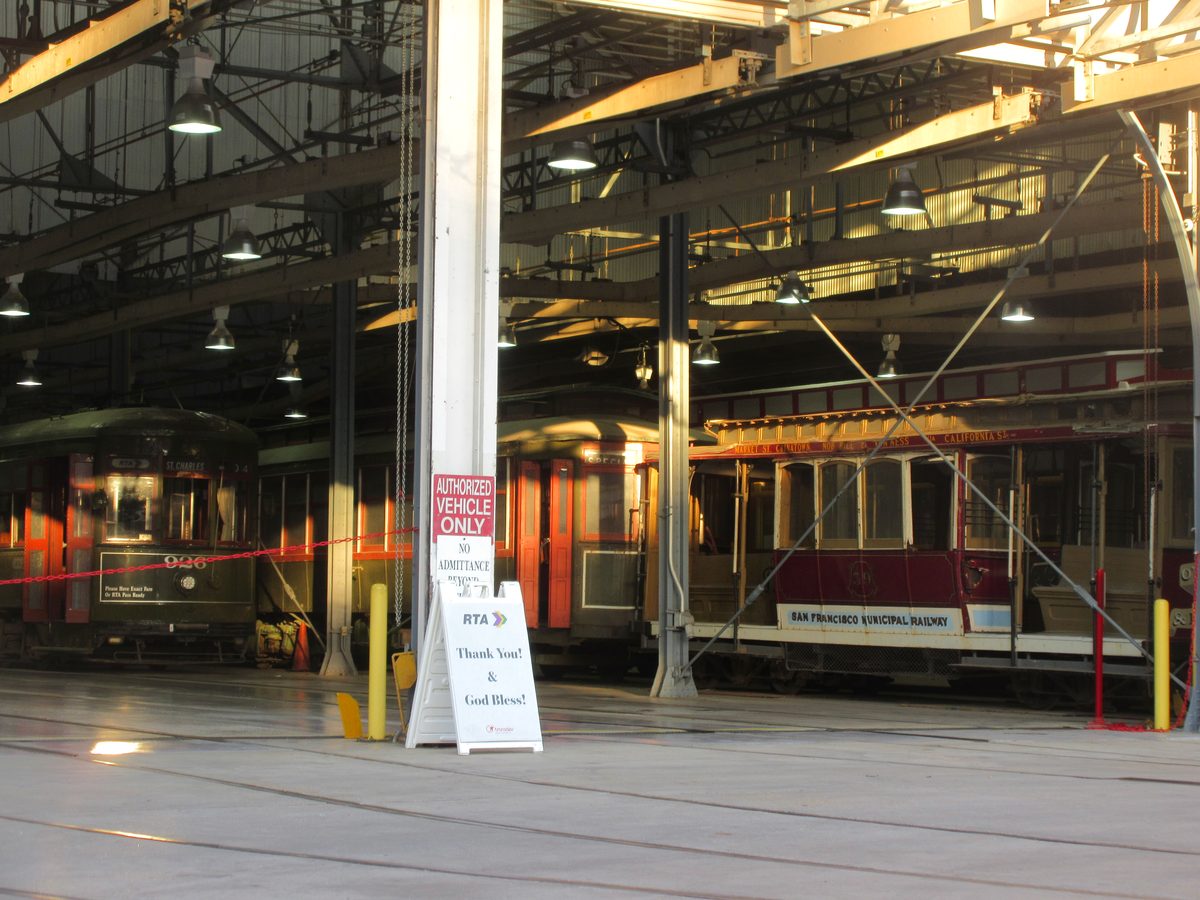
The St. Charles Avenue streetcar line runs from Canal Street through the CBD, into the Lower Garden District, through the Garden District, into Uptown, around Audubon Park, and into Carrollton. Operating continuously since 1835 (the oldest continuously running streetcar line in the world), the line is a National Historic Landmark. The wooden-bench, open-window streetcars are themselves among the most-photographed objects in New Orleans.
Streetcar etiquette is conservative — the line is heavily used by tourists, residents, and Tulane/Loyola students. Visible cannabis use on the streetcar will draw conductor attention and is technically a public-consumption violation. Smell-only is generally not pursued.
Magazine Street
Magazine Street runs roughly parallel to St. Charles, six blocks toward the river. The street is the commercial spine of the Garden District and Uptown — six miles of restaurants, antique shops, art galleries, boutique clothing stores, coffee shops, bars, and yoga studios. The atmosphere is relaxed, walkable, and substantially less tourist-oriented than the Quarter.
Magazine Street's cannabis posture is operationally light. Sidewalk consumption around bars and music venues happens in normal rotation. NOPD presence is moderate but not aggressive on cannabis encounters; the §54-507 framework applies.
Audubon Park
Audubon Park is the 350-acre Olmsted-designed urban park between St. Charles and the Mississippi River, built on the site of the 1884 World's Industrial and Cotton Centennial Exposition. The park contains Audubon Zoo, a public golf course, walking and running paths, and recreational fields. The park is a green public space inside city jurisdiction; the New Orleans City Code prohibits public consumption of cannabis in parks.
Park enforcement of cannabis is light. Tulane runners, dog-walkers, and Sunday picnic groups all use the park; visible smoking attracts attention but is rare. Park Service jurisdiction does not apply — Audubon is a city park, not a federal park, and NOPD has full enforcement authority.
Off-Campus Student Housing
The blocks immediately surrounding Tulane and Loyola are densely occupied by off-campus student housing. The combined undergraduate population is roughly 19,000 students — many living in shared houses, fraternity/sorority chapter houses, and small apartment complexes within ~10 blocks of campus.
NOPD posture in these blocks is operationally light. Tulane University Police (TUPD) has campus jurisdiction but typically does not patrol off-campus residential blocks; that is NOPD 2nd District territory. The DFSCA-driven on-campus posture (see Tulane page) does not extend off-campus. Cannabis presence in off-campus student housing rotation is normal, with the §54-507 framework applying to any street-level encounter.
Caveat for Tulane and Loyola students: off-campus enforcement does not insulate from on-campus consequences. A cannabis-related police encounter off-campus that is reported to the university (NOPD does not routinely do this for §54-507 summonses, but it can happen for state-law arrests) can trigger student-conduct proceedings affecting housing, financial aid, and standing.
The Carrollton End
Past Audubon Park, St. Charles bends west and the streetcar continues into Carrollton, which was an independent town until annexed by New Orleans in 1874. The Carrollton end of the line has a different character — more residential, fewer tourists, the mature Tulane "Audubon-side" houses that backfilled when the park was built. Cannabis posture is similar to the rest of Uptown: operationally light.
The Garden District as a Tourism Destination
Many Quarter visitors take the streetcar Uptown for an afternoon, walking the Garden District streets to see the famous houses (Anne Rice's former mansion on First Street; the Manning family house; Lafayette Cemetery No. 1). Cannabis is essentially absent from this experience — the streets are wide, houses set back, and pedestrian density low. Visitors who use cannabis during a Garden District visit do so privately at AirBnBs or before arrival at the streetcar.
Practical Tips
- Stay or visit Uptown for a quieter cannabis experience than the Quarter offers. The 2nd District NOPD posture and lower officer density make for a different operational environment.
- Magazine Street is highly walkable. Coffee, food, music venues, restaurants on a six-mile commercial spine.
- Audubon Park is a city park, not federal. NOPD 2nd District has authority; cannabis prohibitions apply but enforcement is light.
- St. Charles streetcar etiquette is conservative. Public-consumption violations attract attention.
- Tulane and Loyola off-campus student housing operates with normal cannabis presence in rotation; on-campus DFSCA rules are different.
For in-depth cannabis education, dosing guides, safety information, and research summaries, visit our partner site TryCannabis.org
Related on this site: Cannabis in Algiers, Cannabis in the French Quarter (Vieux..., Cannabis in the Lower Ninth Ward.