
Last verified: April 2026
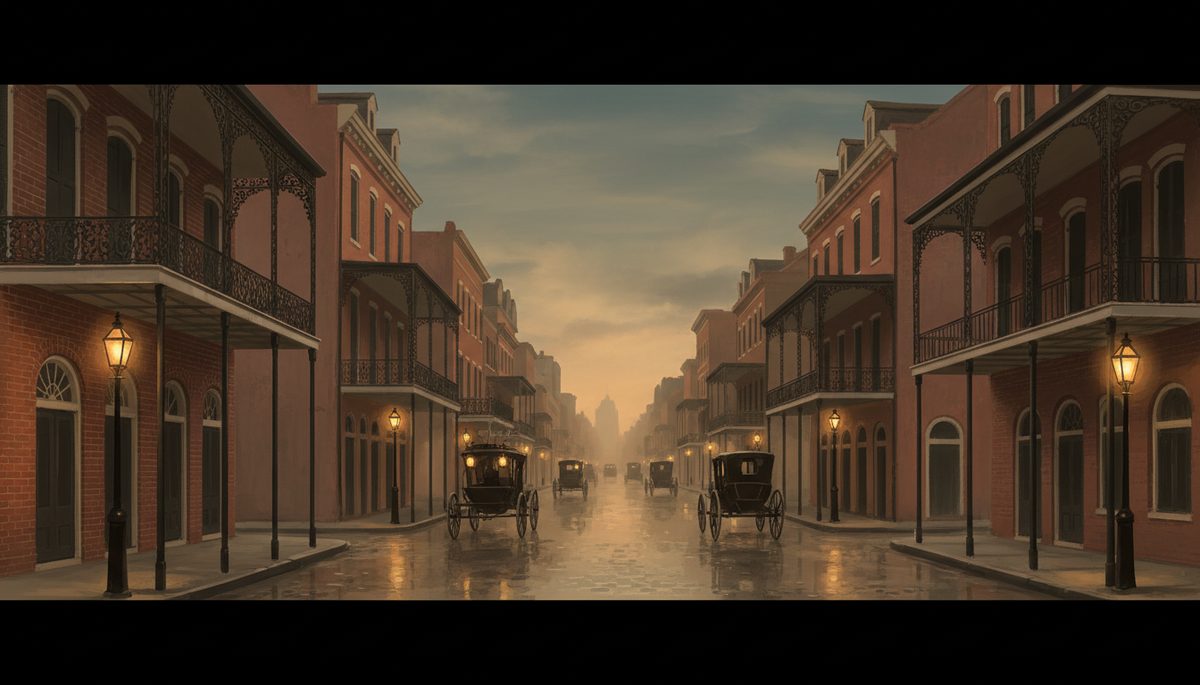
The Ordinance
On July 6, 1897, the New Orleans City Council passed an ordinance authored by alderman Sidney Story that designated specific blocks of the city as the only zone in which prostitution would not be prosecuted. The ordinance did not legalize prostitution; it was a non-enforcement zoning measure. Story, a Republican and a respectable businessman, opposed the policy on moral grounds but believed concentrating the trade in one quarter was preferable to its dispersal throughout the city. He was reportedly horrified that the district was named "Storyville" by the press.
The district occupied 38 blocks adjacent to the French Quarter, bounded roughly by:
- Iberville Street on the south
- St. Louis Street on the north
- North Basin Street on the west
- North Robertson Street on the east
Storyville was thus immediately adjacent to the French Quarter on the lake side of present-day Iberville. The "back-of-town" — the area further inland from the quarter, including portions of present-day Tremé and Iberville — overlapped operationally with Storyville and produced much of the working-musician community that defined the era's musical innovations.
The District's Operation
Storyville contained a wide range of establishments: "sporting houses" ranging from upscale Basin Street mansions (Lulu White's Mahogany Hall, Countess Willie Piazza's parlor, Josie Arlington's establishment) to low-end "cribs" — rooms-by-the-hour shacks. "Blue Books" — guides to the district's prostitutes, advertising names, ages, and prices — were published periodically and survive as historical documents.
The economy of Storyville was built around three things: prostitution, alcohol, and music. The musical economy — pianists in parlor houses, brass bands at funerals and parades that overlapped with the district, small ensembles in saloons — supported a working-musician community of unprecedented scale for its era.
The Musical Innovations
The musicians who came up in or through Storyville include nearly every foundational figure of jazz history:
- Buddy Bolden (1877–1931) — the cornetist often identified as the first jazz player. Bolden's working venues overlapped Storyville. He suffered a mental breakdown in 1907 and spent the rest of his life institutionalized.
- Jelly Roll Morton (1885 or 1890–1941) — pianist, composer, self-aggrandizing autobiographer who claimed to have "invented jazz" in 1902. His Library of Congress recordings made by Alan Lomax in 1938 are foundational documents of early jazz history. Worked extensively in Storyville parlor houses.
- King Oliver (1881–1938) — cornetist who led the Creole Jazz Band; mentored Louis Armstrong; recorded crucial early jazz documents in Chicago in 1923.
- Sidney Bechet (1897–1959) — soprano saxophonist and clarinetist; one of the most virtuosic of the early jazz innovators; worked Europe extensively after Storyville closed.
- Louis Armstrong (1901–1971) — born in the Iberville-Tremé back-of-town near Storyville; came up playing in this environment; left for Chicago in 1922; transformed jazz forever. See Armstrong & "Muggles".
- Kid Ory (1886–1973) — trombonist and bandleader who recorded with Louis Armstrong and Jelly Roll Morton.
- Bunk Johnson (1879–1949) — cornetist of the early generation, partly remembered through 1940s revivalist recordings.
The musical practice these figures developed — ragtime, blues, and parade-band traditions synthesized into early jazz — laid the foundation for what became a global musical revolution.
The Cannabis Connection
Cannabis circulated openly in Storyville and the adjacent back-of-town in the years 1900–1917. Several factors converged:
- Port-trade supply. New Orleans's continuous Caribbean and Gulf-of-Mexico maritime trade brought cannabis (then often called "muggles," "gage," or by various local names) through the port via merchant sailors, dockworkers, and the various commercial relationships with Cuba, Mexico, and the Caribbean.
- Working-musician demand. Working-musician culture in late-night Storyville environments included alcohol, opium derivatives, cocaine (then legally available in pharmacy preparations), and cannabis. Cannabis was the cheapest, most-tolerated, and least-debilitating of the available options for musicians who needed to play multiple sets per night.
- Limited federal regulation. The federal Pure Food and Drug Act (1906) addressed labeling but not prohibition. The Harrison Narcotic Act (1914) addressed opiates and cocaine but not cannabis. Cannabis was unregulated at the federal level during the Storyville era.
- Local tolerance. Storyville's non-enforcement environment for prostitution extended to other low-priority drug enforcement. Cannabis use, in this environment, attracted little official attention.
This produced the cultural greenhouse in which the American cannabis vocabulary developed (see Jazz Cannabis Vocabulary) and from which the Black New Orleans–Chicago jazz musical-cannabis lineage carried forward.
The Closure (November 1917)
On November 12, 1917, in the months following U.S. entry into World War I, the U.S. Department of the Navy ordered Storyville closed. Naval personnel stationed at the New Orleans Naval Base were prohibited from entering the district (Secretary of the Navy Josephus Daniels had been a vocal anti-prostitution advocate). New Orleans City Council, under federal pressure, formally closed the district.
The closure had several immediate effects:
- Musicians dispersed. Many Storyville musicians moved to Chicago, where the Black-population growth of the Great Migration created comparable musical-economy conditions. Louis Armstrong's 1922 move to Chicago to join King Oliver's Creole Jazz Band is the most famous instance.
- The district's buildings deteriorated. Most of the Basin Street mansions were demolished in the 1930s and 1940s.
- The St. Bernard / Iberville housing project was built on much of the former Storyville footprint as a Public Works Administration project in the 1940s.
- Cannabis circulation in the city continued, but the legally tolerated environment that supported it disappeared. By the 1937 Marijuana Tax Act, cannabis was illegal at the federal level and Louisiana had begun aggressive prosecution.
What Storyville Was Not
Storyville was not a multi-racial utopia. The district was racially segregated, with separate establishments for Black and white clientele. The musical economy mostly involved Black musicians performing for predominantly white patrons in white-clientele establishments, with the Black musicians paid less and treated worse. The "octoroon" advertising in Blue Books trafficked in racial fetishism that was a continuation of antebellum exploitation patterns.
Storyville was also not a place anyone — particularly the women who worked there — chose freely. Most prostitutes in Storyville were trapped by economic precarity, debt bondage to madams, or family circumstances. The romanticization of Storyville in subsequent decades has often elided this exploitation.
The Legacy
Storyville produced two enduring legacies:
- The musical revolution that became jazz. Buddy Bolden, Jelly Roll Morton, King Oliver, Sidney Bechet, Louis Armstrong, Kid Ory — the trajectory of these musicians and their innovations defines 20th-century American music globally.
- The cannabis-cultural lineage that became modern American cannabis culture. The vocabulary, the working-musician adoption pattern, the urban-Black-cultural-leadership pattern of cannabis use that defined American cannabis culture for the next 50 years all trace to Storyville and the immediately adjacent back-of-town.
The 2010, 2016, 2020, and 2021 reforms of New Orleans's cannabis law (see §54-507 and DA Williams declination) operate in some sense as a return to the Storyville-era posture: cannabis is operationally tolerated for personal use within the city, with criminal-justice resources directed elsewhere. The historical irony of New Orleans returning to the Storyville-era cannabis posture, after a century of intervening federal prohibition, is one of the more interesting policy stories in U.S. drug-policy history.
For in-depth cannabis education, dosing guides, safety information, and research summaries, visit our partner site TryCannabis.org