
Last verified: April 2026
The Neighborhood
Faubourg Tremé ("treh-MAY") sits immediately north of the French Quarter, bounded roughly by North Rampart Street, Esplanade Avenue, North Broad Street, and St. Bernard Avenue. It was platted in the 1810s by Claude Tremé on the site of an earlier plantation. By the 1830s, Tremé had become the residential heart of New Orleans's free people of color (gens de couleur libres) — a substantial Creole community that, before the Civil War, had property rights, education, and political influence unmatched anywhere else in the antebellum U.S. South.
This community produced much of the foundational early jazz and traditional New Orleans brass-band music. Congo Square, in present-day Louis Armstrong Park at Tremé's edge, is where enslaved Africans were permitted to gather on Sundays during the antebellum period, preserving West African, Caribbean, and Afro-Catholic musical and ritual traditions. Many scholars trace the deepest African roots of jazz to the polyrhythmic and call-and-response practices that survived through Congo Square.
Tremé's Cannabis-Cultural Lineage
Tremé and the immediately adjacent Storyville back-of-town were the cultural environment in which early-20th-century cannabis culture emerged in working-musician communities. Louis Armstrong was born in 1901 in the Iberville-Tremé back-of-town, in the section then called "the Battlefield," to a family of profound poverty. He grew up in this environment.
The early-1910s Storyville musical economy operated alongside cannabis circulation among musicians; New Orleans's port-trade economy provided supply (Caribbean and Mexican imports came through the river); the working-musician late-night culture provided demand. By the time Storyville closed in November 1917 and Armstrong left for Chicago in 1922, the cultural environment that produced "muggles," "gage," "tea," and "viper" was fully formed in this neighborhood.
NOPD Posture in Tremé
NOPD's 1st District covers Tremé and the CBD/Quarter-adjacent areas. Officer density is moderate — higher than Uptown, lower than the Quarter. Patrol presence focuses around the perimeter (Rampart, Esplanade, Claiborne) more than inside the dense residential blocks.
Tremé's contemporary cannabis posture is shaped by a complicated history. Pre-2010, Tremé was among the highest-arrest neighborhoods in NOPD's marijuana-arrest data, contributing materially to the 7-to-1 Black-to-white arrest disparity that ACLU and Vera Institute analyses documented citywide. Disproportionate enforcement of low-level marijuana possession in Black neighborhoods like Tremé was one of the major drivers of the 2010 §54-507 ordinance, the 2016 Landrieu expansion, and the 2020 Cantrell mandatory-cite-and-release amendment.
Post-2020 and post-2021 (Williams declination), Tremé sees the §54-507 cite-and-release framework operating as designed: custodial arrest for personal-use possession is rare; municipal summonses replace state-law referrals; the DA declines what state-law arrests reach the office. The effect on Black-neighborhood cannabis-related police contact has been substantial, though disparity-monitoring reports continue to flag patterns deserving ongoing attention.
Second Lines and Brass Bands
Tremé is the heartland of the second line tradition — the procession of dancers, bystanders, and casual marchers that follows a brass band through the neighborhood. Second lines are organized by Social Aid & Pleasure Clubs (SA&PCs), Mardi Gras Indian tribes, and brass-band associations; they happen weekly during the August-through-June season and connect to funerals, anniversaries, weddings, and clubs' public-display traditions.
The cannabis posture during second lines is operationally similar to Mardi Gras: officer presence is real (NOPD permits second-line parades and provides traffic-control), but the cite-and-release framework applies. Cannabis aroma at the trailing edge of second-line crowds is common; smoking in plain sight at the head of the procession draws attention.
Congo Square and Louis Armstrong Park
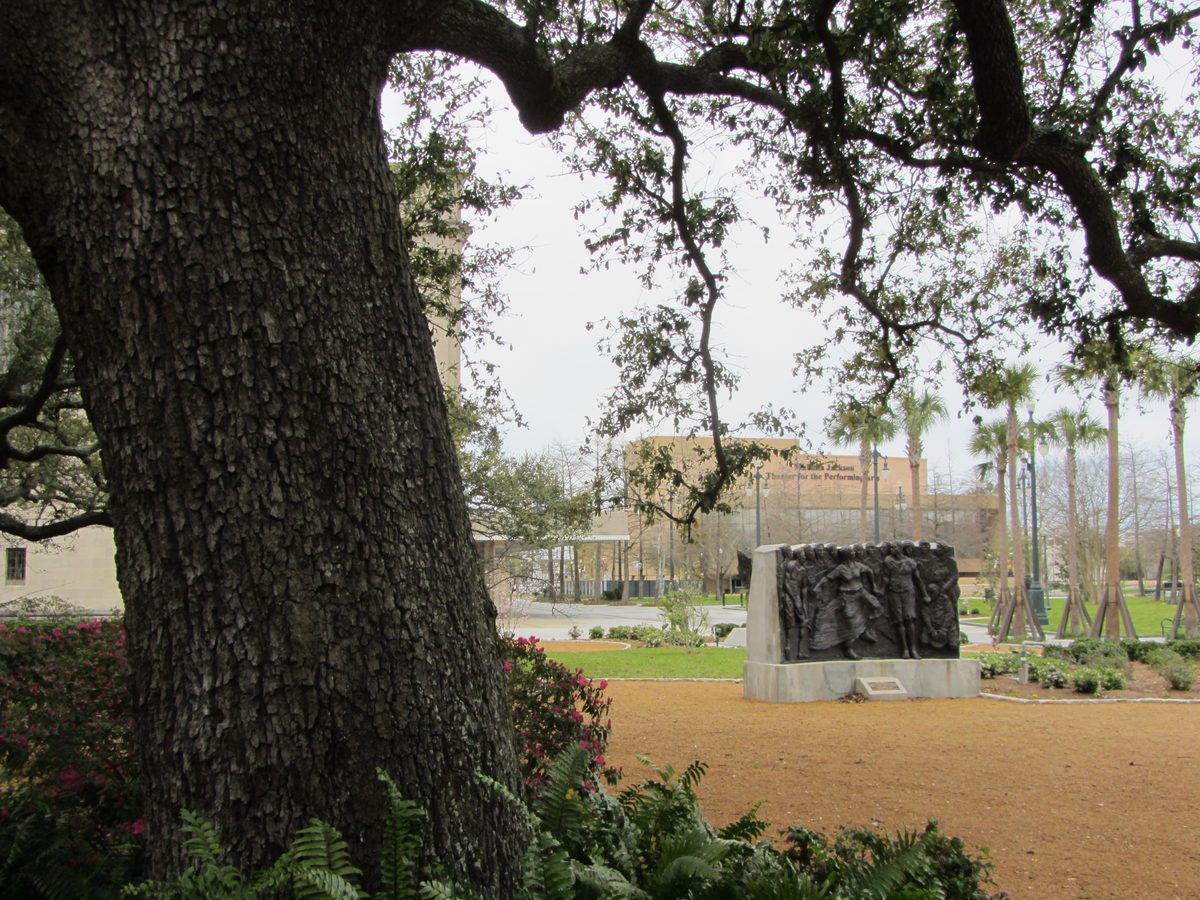
Louis Armstrong Park, on Tremé's western edge, contains Congo Square, the Mahalia Jackson Theater, and the Municipal Auditorium. The park is a city park; the New Orleans City Code prohibits public cannabis consumption in parks. Enforcement is light during daytime hours; visible smoking attracts attention.
Congo Square hosts informal Sunday drumming circles in continuous tradition with the antebellum gatherings. These are public events; cannabis presence is in normal rotation but not openly displayed. The park's federal-adjacency (the Mahalia Jackson Theater hosts federal-grant programming) creates some tightening of posture relative to outright residential blocks.
St. Augustine Catholic Church
St. Augustine Catholic Church, on Governor Nicholls Street, is the oldest African American Catholic parish in the U.S. Founded in 1841 by gens de couleur libres who pooled funds to buy pews for enslaved people to worship alongside themselves. The church remains active and serves a substantial portion of Tremé's Black Catholic community. Cannabis posture in the immediate blocks around the church is quieter than residential Tremé generally — Catholic-community-adjacent neighborhoods have somewhat tighter operational norms.
Backstreet Cultural Museum
The Backstreet Cultural Museum at 1116 Henriette Delille Street is a small but essential institution documenting Mardi Gras Indian masking, Skull and Bones gangs, baby-doll groups, and the second-line tradition. It is one of the most important cultural institutions in NOLA for understanding the Black New Orleans traditions that overlap with the cannabis-cultural lineage.
The Treme HBO Series Effect
David Simon's HBO series Treme (2010–2013) brought international attention to the neighborhood post-Katrina. The show featured working musicians, second-line traditions, and the recovery economy, and contributed to a tourism uptick. Tremé has not become a tourist neighborhood the way Marigny has — the residential character remains — but tour buses and walking tours operate.
Visitors should be aware that Tremé is a real residential neighborhood with people whose lives are not part of a tourist experience. Photographing children, intruding on private events, or treating sidewalk gatherings as photo opportunities is widely (and rightly) considered offensive.
Practical Tips
- Visit Tremé respectfully. Walking tours, museum visits, second-line participation when invited.
- Cannabis posture in Tremé is residential-quiet. Operationally light NOPD presence in residential blocks; tighter near Louis Armstrong Park and federal-adjacent buildings.
- Second lines are a real cultural form, not entertainment. Following respectfully, contributing to the Social Aid & Pleasure Club's purpose, and not interfering with the brass band's performance is the etiquette.
- Backstreet Cultural Museum is essential. $10–$15 admission supports preservation of irreplaceable cultural archives.
- St. Augustine Catholic Church hosts mass with traditional music; visitors are welcome to attend Sunday services.
For in-depth cannabis education, dosing guides, safety information, and research summaries, visit our partner site TryCannabis.org